An apparel MOQ is not a house rule; it is the sum of four cost floors: fabric dye-lot minimum, trim minimums, line changeover time and carton fill. On a woven cargo pant using 1.8 m of fabric, a 300 m dye lot sets a floor near 165 pieces per colour — negotiate that, not the price list.
Buyers usually meet MOQ as a single figure in a quotation, and either accept it or ask for a discount on it. The number behaves better when it is treated as arithmetic. GorgeousBen, a menswear manufacturer in Shishi, China, quotes MOQs to wholesale buyers in dozens of markets, and the conversations that go well are the ones where the buyer asks which cost line is binding. This guide walks through those lines, the levers that move them, and what to put in writing.
What an MOQ Really Is: Four Cost Lines, Not a Rule
A factory loses money below a certain quantity for concrete reasons. Four of them decide almost every apparel MOQ, and they are rarely equal — usually one dominates:
| Cost line |
Typical floor (common practice) |
What it means for a buyer |
| Fabric dye-lot minimum |
300–500 m per colour, piece-dyed |
At 1.8 m per piece, roughly 165–275 pieces per colour |
| Trim minimums |
Zippers 1,000–3,000 pcs; custom buttons or drawcords 2,000–5,000 pcs |
One trim can set the order size regardless of fabric |
| Line changeover |
2–4 hours of line time per style switch |
Setup cost does not shrink with the order |
| Carton fill |
20–40 pcs per export carton |
Part cartons add freight and handling cost |
Ask a supplier which of the four is driving the quote. The answer tells you where flexibility exists: a fabric-driven MOQ can move if you accept stock fabric, while a trim-driven MOQ will not move no matter how the order is split.
The Fabric Arithmetic Behind a Per-Colour Minimum
The dye-lot rule explains most of what buyers find puzzling about MOQ. A piece-dyed fabric is dyed in a single bath; below a few hundred metres, the dyehouse charges a minimum batch price that the mill passes on. So the factory converts metres into pieces: 300 m divided by 1.8 m per piece is 167 pieces, and that becomes the per-colour MOQ whether or not anyone mentions fabric. If your consumption is higher — a long parka, a wide-leg trouser — the same dye lot supports fewer pieces. Fabric weight and width change the arithmetic directly, which is why GSM and width decisions made early affect order quantity later.
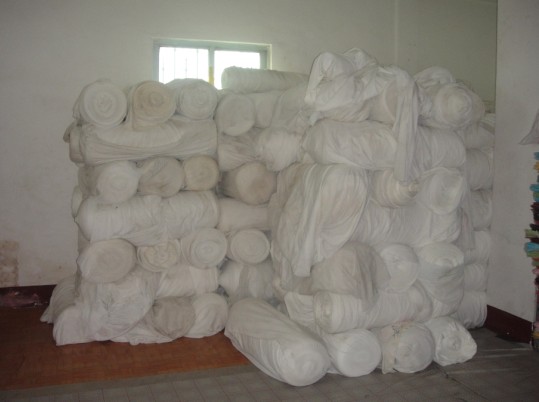
Fabric rolls kept by dye lot at GorgeousBen — the lot, not the order, sets the per-colour floor.
Per Style, Per Colour, Per Size: Three Different MOQs
Most MOQ disputes are really vocabulary problems. Three minimums can apply to the same order, and the quotation usually names only one:
- Per style — total units across all colours and sizes. This is the figure buyers usually mean.
- Per colour — driven by the dye lot. Four colours at 100 pieces each can fail a 300 m minimum even when the style total looks healthy.
- Per size — driven by cutting efficiency and carton fill. A wide size curve spreads the same units thinner, and the tail sizes may not fill a cutting table economically. See size range planning for how that trade-off affects dead stock.
Before negotiating anything, ask which minimum binds. A quote of 500 pieces per style that turns out to be 250 per colour in four colours is a different conversation from a flat 500.
Five Levers That Move MOQ Without Damaging Price
These are the levers a factory can usually work with, in rough order of effectiveness:
- Consolidate colours. Fewer colours, more depth each. Four colours at 150 pieces is easier than eight at 75, and it keeps the dye-lot count down.
- Choose stock fabric or greige. No dye lot minimum applies, so the MOQ collapses to cutting and sewing minimums.
- Accept a longer lead time. A small order can slot into gaps between larger runs. Waiting two or three weeks longer is often cheaper than paying a setup surcharge; the lead time mechanics for smaller orders explain where those slots come from.
- Take the trim surplus. Pay for the full trim minimum and keep the spares for a reorder, instead of asking the factory to absorb stock it may never use.
- Commit to a forecast. A first order at the floor plus a dated second order is a stronger offer than a single small order with a vague "we will see how it sells".
What Not to Trade Away for a Lower MOQ
A smaller order usually carries a higher unit price, because setup costs are fixed. That is normal and worth paying; these are not:
- Inspection depth. Reducing checkpoints to save cost is how a small order arrives with a defect rate the buyer discovers at retail. Small orders need the same quality control structure as large ones.
- Pre-production sample approval. Skipping the PPS step to save a week removes the only chance to catch a construction error before cutting.
- Written measurement tolerances. Verbal "within a centimetre" is not a tolerance.
- Silent fabric substitution. If a cheaper quality replaces the approved one, the order is no longer the order that was priced.
- Packing standards. Polybag, hangtag and carton specifications do not become optional at low volume.
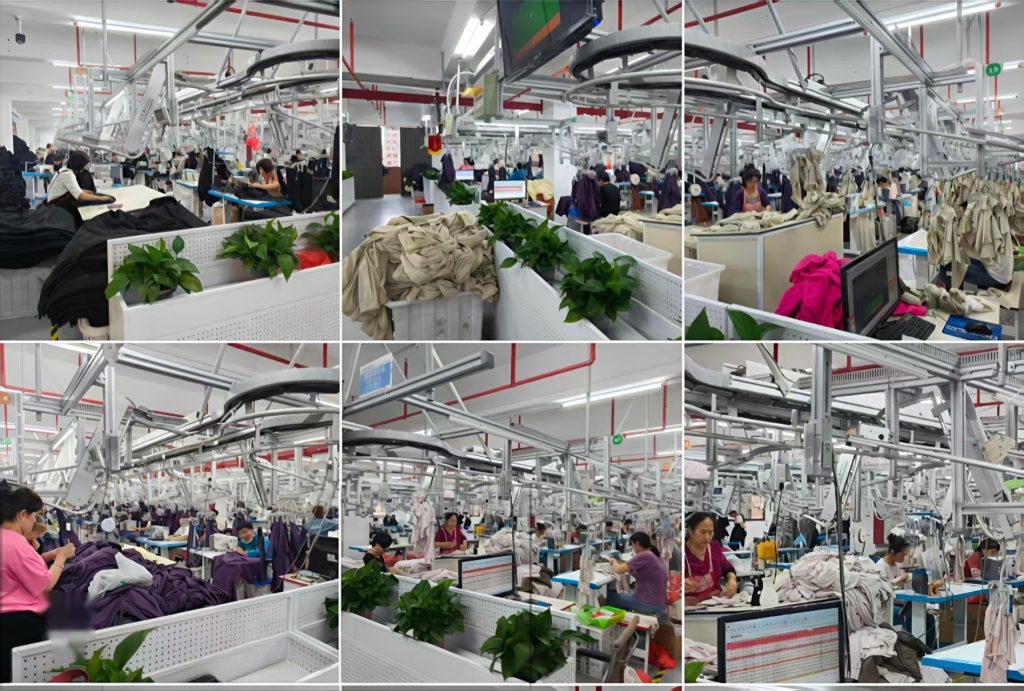
A hanging sewing line at GorgeousBen — every style switch costs setup hours that a small order still has to cover.
What to Put in the MOQ Clause
Whatever is agreed verbally should appear in the order confirmation, in these terms:
- Per-style and per-colour minimums, stated separately, with the colour list attached.
- The surcharge trigger — at exactly what quantity does the unit price step up, and by how much.
- The reorder MOQ, which is often lower than the first-order MOQ because fabric and trims are already on file.
- Price validity tied to the quantity tier, so the number does not drift between sampling and order. Currency and validity clauses belong in the same paragraph as the price validity terms.
- Substitution rules — what may change without written approval, and what may not.
Red Flags in an MOQ Conversation
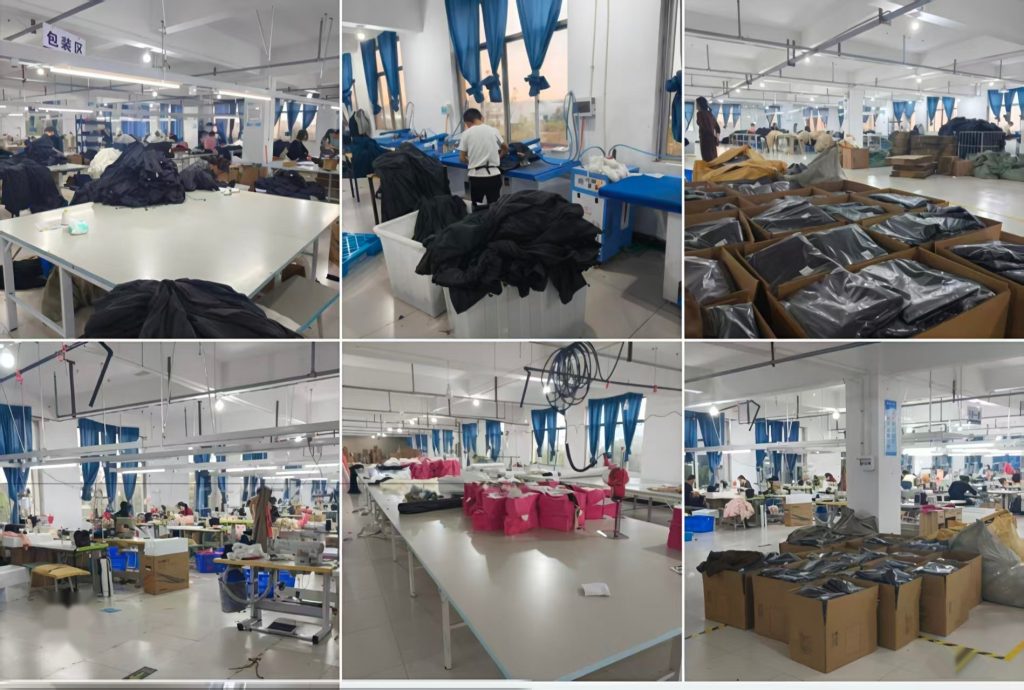
Carton fill at the GorgeousBen packing area — part cartons are one reason small orders cost more per piece.
Frequently Asked Questions
What is a normal MOQ for clothing manufacturing?
As common practice, woven menswear orders start at roughly 300–500 pieces per style, with a per-colour minimum set by the fabric dye lot. Knitwear and stock-fabric programs can go lower because the dye-lot constraint disappears. The honest answer is that the number depends on the fabric, the trims and the line, so a factory quoting one figure for every product is quoting an average rather than your order.
Can MOQ be negotiated down on a first order?
Yes, usually by changing a condition rather than by asking for a favour: accept stock fabric, consolidate colours, take the trim surplus, or accept a later delivery slot. Buyers who arrive with one of those options built into the request usually get a workable answer in the first round, because the factory can see which cost line is being absorbed.
Is a lower MOQ always more expensive per unit?
Almost always, yes. Fabric minimums, trim minimums and changeover time are fixed costs, and spreading them over fewer pieces raises the unit price. The useful question is not whether the unit price rises but whether the increase matches the setup costs involved. A transparent factory will show which of the four cost lines the surcharge pays for.
Does MOQ differ between OEM and ODM orders?
Usually, yes. An ODM order can ride on an existing pattern, fit and fabric, so the minimum is closer to a fabric and line minimum. An OEM order adds pattern making, grading and fit approval, and factories often set a higher first-order minimum to cover that development work. The OEM versus ODM comparison covers where that cost sits.
Start With the Number Your First Season Can Carry
Negotiating MOQ is not about pushing a supplier down; it is about finding the smallest quantity that still makes engineering and commercial sense for both sides. Ask which cost line binds, offer a condition instead of a request, and put the result in writing. GorgeousBen quotes per style and per colour with the driver named, so buyers can see what moves and what does not. Contact GorgeousBen with your style, fabric and target quantity, and browse the menswear range for reference.


